
Buying Back the Months Epoxy Gives Up
Resin chemistry slows as concrete cools, and around October an unheated Chester slab drops below where epoxy performs. Polyaspartic keeps reacting across a much colder band, which is why so many fall and spring installs run on it. The trade is a working time measured in minutes. Call (445) 444-2879 or ask for a free quote.
Every October we field the same call. Somebody has been told their garage or their back patio has to wait until spring, and they want to know whether that is true or whether they are being managed. It is true for one material and not for the other, and the difference is worth understanding before you schedule anything, because it decides which half of the year your floor is available to be built in.
Concrete temperature, not air temperature
The number that governs a resin install is the temperature of the slab, and it lags the air by a long way. Concrete has mass, so a detached garage floor sits near the average of the last several days rather than whatever the thermometer says at nine in the morning. A mild afternoon in November does not mean the slab is mild.
That lag runs the other way too. In spring, a warm week does not immediately warm a floor that spent February near freezing, which is why a March install can be more marginal than the calendar suggests. We take an actual slab reading the morning of the work rather than trusting the forecast, and the number decides whether we proceed.
Around Delaware County the practical picture is that unheated concrete drops out of range for standard epoxy well before winter formally starts. Detached bays, carports, covered porches, and any exterior pad all cross that line early, which is exactly where the fall scheduling problem comes from.

Why this resin keeps working when the other one stops
Push epoxy onto a cold slab and the cure drags. The finish can come out soft or streaky, and below a certain reading it will not reach the hardness it is supposed to at all. It is not a failure you see on day one, which is the dangerous part. The floor looks finished, and then it wears wrong.
Polyaspartic cures across a considerably wider temperature band. The reaction keeps moving at slab readings where epoxy has effectively stopped, which is what puts a covered Chester porch or an unheated garage back on the calendar in months that would otherwise be dead. In practical terms it buys back roughly half the year on concrete nobody heats.
It is not unconditional. We still check the slab reading and the dew point the morning of the install, and if the numbers are wrong we move your date. Coating anyway and handing somebody a floor that fails in March is not a trade we make, and a rescheduled morning is a cheaper conversation than a re-grind.
Condensation is the reading people forget
Cold weather brings a second problem that has nothing to do with cure speed. When a slab is colder than the air above it and the humidity is up, moisture condenses on the surface, sometimes as an invisible film. Coat over that and the resin is bonding to water rather than to concrete, which no material survives.
Dew point is the guard against it, and it is a simple check with real consequences: the slab has to be a margin above the dew point, not merely dry to the touch. Late fall mornings after a warm rainy stretch are the classic trap, because the floor looks fine and reads wet on an instrument.
Below-grade and older pours carry the other moisture question, which is vapor moving up from the ground through a slab that never got a barrier under it. That is a separate test and a separate answer, and where the readings call for it the moisture-tolerant primer goes into the written quote as its own line rather than turning up as a surprise.
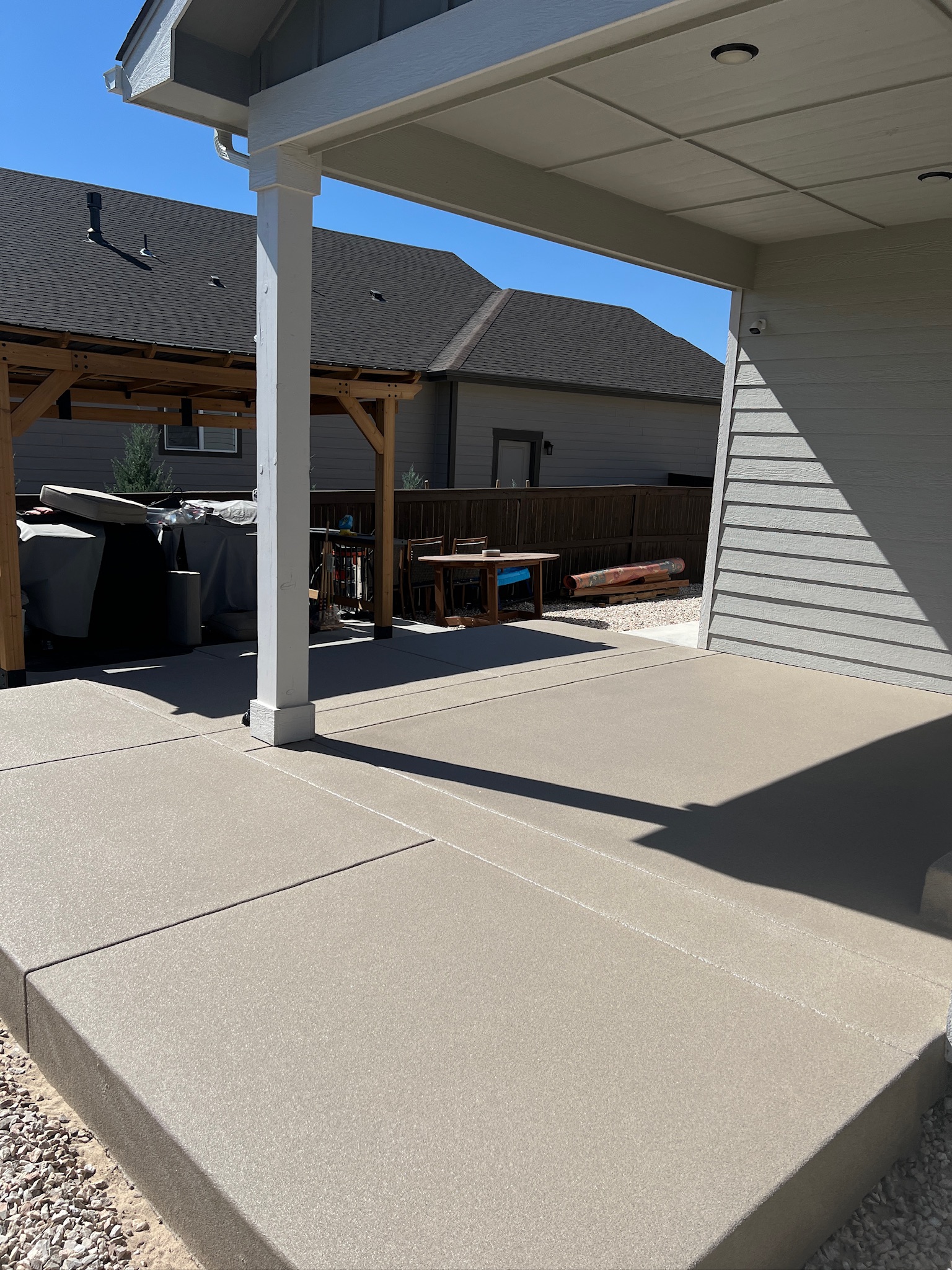
Sun on a patio, and why the clear layer matters outside
Anything uncovered has a second adversary. Ultraviolet light ambers bare epoxy, so a color you chose in April drifts warm and blotchy where the sun lands hardest, and the shaded half of the slab drifts less, which makes the mismatch obvious. On a patio that is split between a covered section and open sky, you end up with a visible line that follows the roofline.
Polyaspartic holds its color under exposure, which is the entire reason it goes on porches, uncovered patios, walkways, and any garage whose door spends the afternoon open. The exposed layer is the one that has to be UV stable, and that is what it is for.
Worth clearing up: choosing this system does not mean accepting a bare gray slab. On most of our floors the polyaspartic is the clear layer over a base that carries the pigment and a chip broadcast that carries the texture. You pick the blend, we lock it underneath, and the finished surface looks like any of our decorative work while gaining the sun and hot-tire resistance. The full breakdown is on our Chester polyaspartic coatings page, with finished slabs in the gallery.
The short working time is where jobs are won or lost
Speed cuts both ways. Once the parts are mixed, a batch has minutes rather than hours, and it does not wait for anybody. A crew that falls behind leaves lap lines where one wet edge cured before the next reached it, roller marks that will never level out, and thin spots that start peeling inside a year. Nearly every failed floor of this kind we have been called to grind off went bad exactly that way. The material performed; the install did not.
So the whole job is planned around the clock. Sections get sized to the day’s temperature, because cold slows the reaction and warmth accelerates it, and the size that works in November is not the size that works in June. Batches are mixed in sequence rather than all at once. The floor moves as one continuous surface so it cures as a single piece.
Prep gets stricter rather than looser, since there is no going back to fix a spot after material is down. Grinding, crack and joint repair, and moisture testing are all finished before anyone opens a pail. None of that shows in the finished floor, which is the point: what you see is an even surface with no seams and no shadows, and what you paid for is a crew that had everything staged before they started.
Questions about cold-season installs
Will you heat my garage to get the job done in January?
In an enclosed bay, yes, and that is often the simplest answer. Bringing the slab into range with heat is straightforward when there are four walls and a door. An open carport or an exterior pad cannot be heated in any practical way, which is where the material’s cold tolerance carries the job instead.
Does a floor installed in cold weather last as long as a summer one?
Yes, provided the readings were right on the day. A properly cured floor is a properly cured floor regardless of the month it went down. What shortens a coating’s life is being installed outside the material’s window, not the season on the calendar, which is why we take the readings rather than the date as the deciding factor.
How much longer are the return times in cold weather?
Somewhat longer, and you get the real numbers for your slab at the walkthrough rather than a brochure figure that assumes a warm shop. Foot traffic the same evening and vehicles the following day is typical in decent conditions. A cold install can push the vehicle window out, and we would rather tell you that upfront.
Do Not Write Off the Rest of the Year
We read the slab, check what light and traffic it takes, and put the scope in writing before a grinder touches it. If epoxy is the better answer for your room, the quote will say so.
Reserve a Walkthrough (445) 444-2879