A porch or patio slab under a roof still takes sun, wind-driven rain, freeze-thaw and tracked-in rock salt. We finish it with a UV-stable topcoat that holds its color, add texture so footing stays sure when the floor is wet, fill the cracks while leaving the control joints free to move, and book the coating day for weather warm enough to cure it. Call (445) 444-2879 or reserve a walkthrough.
A covered porch gets treated like an indoor room by the people who use it and like an outdoor slab by the weather. Coffee in the morning, boots on the mat, a dog waiting by the door to be let in. Then a storm pushes rain sideways under the roof, January brings salt in on everybody’s shoes, and the afternoon sun comes through the railing in the same bright bars every day. A coating on that floor has to live both lives. Here is how we approach porch and patio slabs on Haverford houses, and why some of the answers differ from a garage.
Stripes of sunlight are harder on a floor than shade
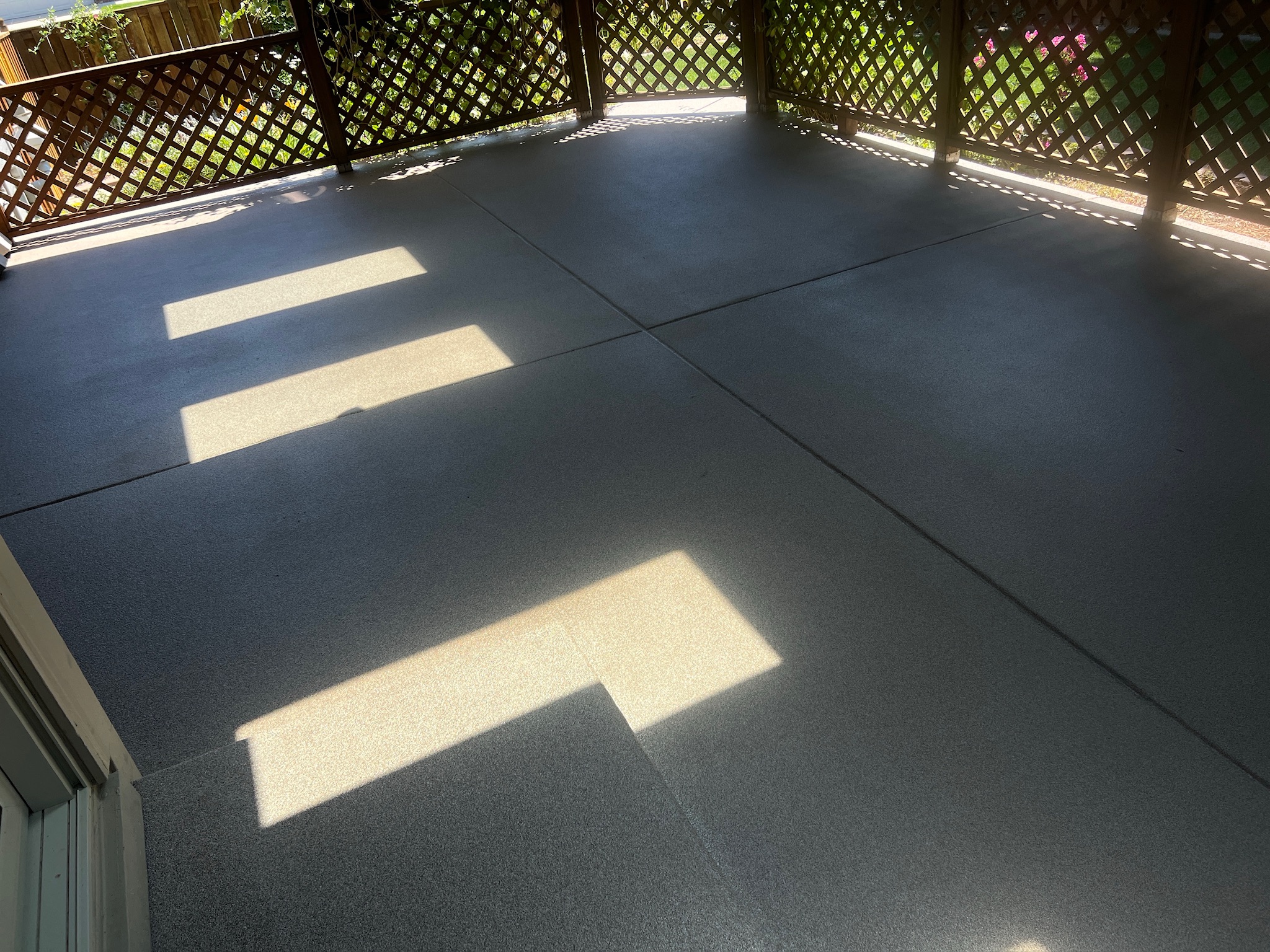
On a covered porch with lattice sides, the light never lands evenly. Light falls across it in bands through the lattice, landing on the same strips of floor every afternoon while the strips beside them stay in shadow. With an epoxy topcoat that was never meant for sunlight, that pattern eventually shows up in the finish: a yellowed, ambered band where the light lands and truer color where it does not. It ends up looking as if someone painted stripes on the porch deliberately.
That is why the top layer on every outdoor slab we coat is a UV-stable topcoat, a product made to keep its color in direct sun. The base coat and the flake underneath can be the same materials we use indoors. The topcoat is what keeps them looking the way they did on the afternoon we finished. On a porch that faces west and catches the long evening light, it is the single choice that matters most. During the walkthrough we will point out which part of your floor gets the most sun, because that is where the floor gets tested first.
Rain blows in, and salt walks in
A roof keeps the worst weather off a porch, but only the worst. Rain rides in on the wind and pools wherever the slab dips. In winter that water freezes inside any open crack and expands, and each thaw lets it work a little deeper. Rock salt comes up the front walk on boots and sits on the porch for weeks at a stretch. Bare concrete soaks all of it in, which is why old porch slabs flake at the surface and pit near the steps.
A sealed, coated slab keeps the water and salt on top, where a broom or a hose can deal with them. The other half of the job is footing. A glossy finish that looks great dry can feel slick with a film of rain on it, so outdoor floors get texture. Broadcast flake gives some by itself, and we add a fine grit to the topcoat where people step off the stairs or come in from the yard. You can feel the difference under a wet sole. We would rather a porch look a little less like a mirror than have anyone slip on it. Our patio coatings page for Haverford houses lays out the outdoor systems we use and how they are built.
The saw cuts stay, and the cracks get filled
The porch in our photo shows its saw-cut joints right through the finished coating, and that was intentional. Control joints are cut into a slab to give the concrete a planned place to crack as it swells and shrinks through the seasons. If a coating bridges a joint and glues it shut, the slab cracks somewhere else, usually straight through the middle of the new floor. So we keep the joints honored: the coating follows each cut and the joint stays able to move.
Random cracks are a different story. Those we open up, clean out and fill with a repair material before any coating goes on, so the finished surface is level and water has no way to slip underneath. Prep on an exterior slab also means removing whatever is already there, which is often an old porch paint peeling at the edges. That film has to go so the new system bonds to the concrete itself. Our epoxy floor prep page walks through how we grind and clean a slab before a single coat is mixed.
Outdoor coating runs on a season
Indoor floors can be coated most of the year. Outdoor floors depend on temperature, and the forecast high is only part of it. The coatings we use each have a range of air and slab temperatures they need while they cure, and a shaded porch slab can sit well below the air above it. A cold night right after coating day can leave a floor soft, cloudy or poorly bonded. Dew settling on a fresh topcoat in the evening is another thing we keep an eye on.
So porch and patio work around Haverford gets scheduled in the warmer part of the year, and we pick coating days by looking at the overnight lows as well as the daytime numbers. If you call in the middle of winter, we are glad to come look at the slab, put the plan and the quote in writing, and hold a coating day for when the weather turns. Waiting a few weeks beats rushing a floor into a cold snap. When the season opens, the floors already on the calendar go first, so an early walkthrough helps.
Porch and Patio Questions
Will a coating make my porch slippery when it rains?
Not when the finish is built for outdoors. We add texture through the flake and, where it is needed, a fine grit in the topcoat at the steps and doorways. The floor will look a bit less glassy than a garage floor indoors, and that small trade is what keeps your footing sure on a wet morning.
Why does the old paint on my porch keep peeling?
Usually because it was rolled onto concrete that was never opened up, and water and freeze-thaw got under the film. Paint sits on the surface. We grind the old coating off so the new system bonds to the concrete itself, which is what separates a porch you redo over and over from one you stop thinking about.
Can you coat a patio that has no roof over it?
Yes. The same rules apply with more weight behind them: a UV-stable topcoat, texture for footing, joints left free to move and a coating day picked around the temperature. An open patio sees more sun and more standing water than a covered porch, so we talk through those trade-offs before you choose a color.
Can I book a porch coating over the winter?
You can book the walkthrough any time. We will look at the slab, write up the plan and the quote, and hold a coating day for the warmer months, when both the air and the concrete are warm enough to cure the system properly. Outdoor floors are the one job we never push into the cold.
Your porch is the first floor a guest stands on. If yours is peeling, pitted or just plain gray, we will come take a look. We work out of Broomall, a short drive away, and the quote is free and itemized. Browse finished floors in our gallery, see what else we do on our Haverford page, or start on the contact page.
Give the Porch a Floor Built for Weather
UV-stable topcoats, textured footing and control joints left free to move, scheduled for the right part of the year.
Reach the Crew Reserve a WalkthroughOur full Haverford Patio Coatings page · See finished floors · Request a quote
