Chestnut Hill Garage Floor Coatings
Flake and polyaspartic coatings for the old slabs behind Chestnut Hill’s stone houses. We grind them, repair them, and finish them so they stop shedding dust and start looking like a room.
Old concrete is a different job.
Most of the garage floors we coat up here were poured somewhere between sixty and a hundred years ago. That is the whole story of the neighborhood in one slab. A schist-walled house on a side street off Germantown Avenue usually has a detached garage or a converted carriage house behind it, and the concrete in there has been through more winters than anybody living in the house. It cracks, it pits, it wears smooth in the tire tracks and rough everywhere else, and somebody along the way rolled a coat of porch paint over the whole thing and hoped.
None of that rules out a coating. It rules out a shortcut. Out in the newer developments a crew can grind a clean twelve-year-old slab and start laying material the same morning. Here we spend real time on the front half of the job: taking the old paint off, opening the concrete to a proper profile, chasing every crack, and rebuilding the apron by the door where the salt has been chewing since the Nixon administration. Do that part right and the finish coat is the easy part.
The floors we hand back look nothing like what people expect from a garage. Full flake broadcast, a gloss that reads more like a showroom than a storage bay, and a surface you can sweep in two minutes instead of chipping oil off with a putty knife. Have a look at the finished floors in our gallery and you will see what an old slab can turn into.
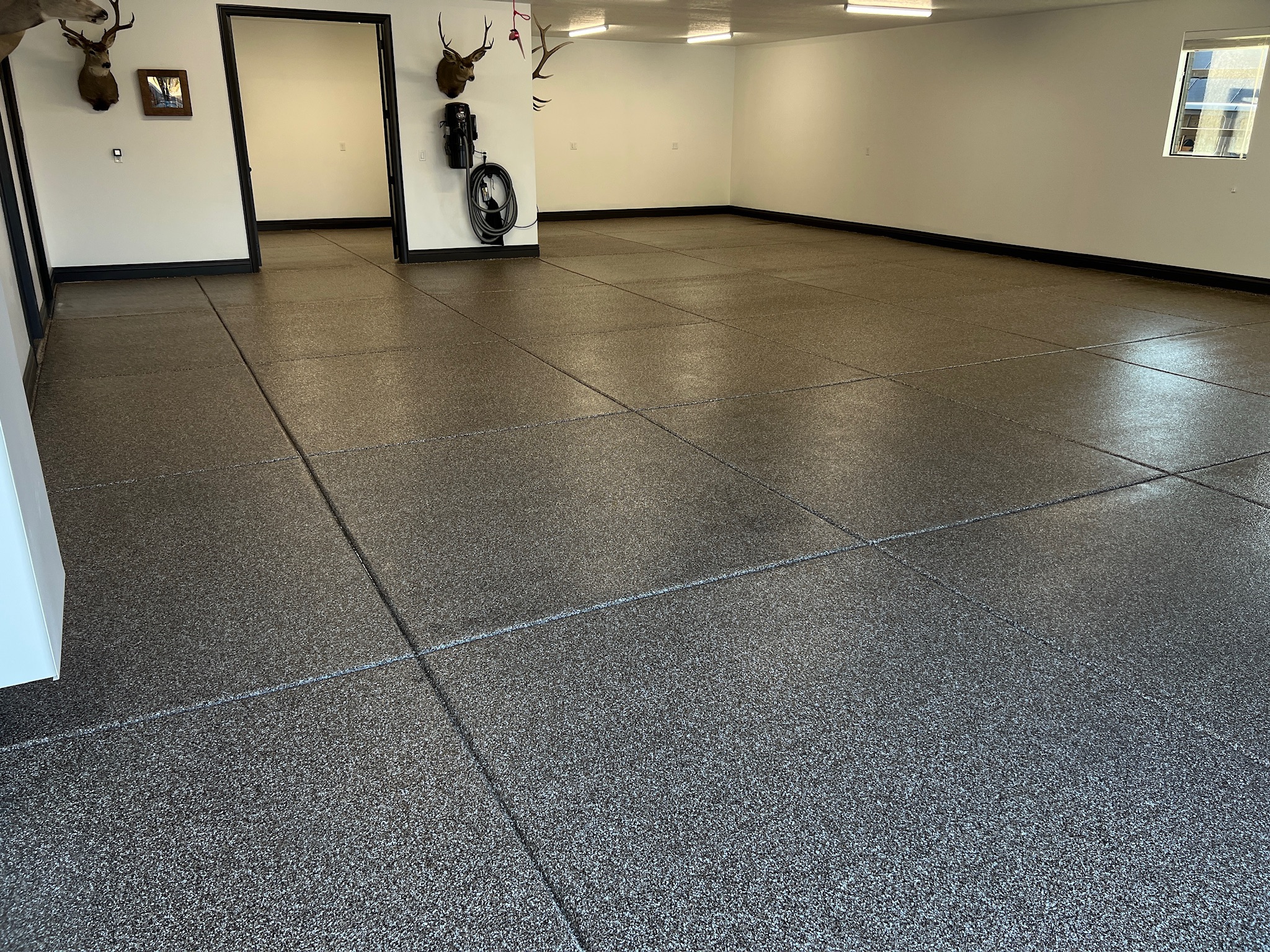 Full flake broadcast with a polyaspartic topcoat, the finish we build most often for a two-car bay.
What actually happens on your floor
Six stages, in this order, every time. Nothing here gets skipped because a slab looks fine at a glance.
We read the slab first
Moisture test, contamination check, and a walk over every crack and low spot with a light. The written scope comes out of that reading, and prep is itemized in it rather than discovered later.
Old coatings come off
Porch paint, sealer, a failed kit from a previous decade. Whatever is on the slab gets ground away rather than coated over, because a new system is only as sound as what it bonds to.
Diamond grind to profile
Mechanical grinding across the whole floor, into the corners, out to the apron. No acid etching. The grind is what opens the concrete so the primer can key into it, and it is the step every failed floor we tear out had skipped.
Cracks and spalls rebuilt
Control joints honored, cracks routed and filled with structural polymer, pitted areas and the crumbling door edge built back level. On a slab this old that work is most of the day, and it is the reason the finish stays flat.
Primer, base, flake
Penetrating primer keyed to the profile, pigmented epoxy base laid at full mil thickness, then vinyl flake broadcast to refusal into the wet base, scraped back and vacuumed clean.
Polyaspartic topcoat, then a walkthrough
A topcoat rated for hot tires and road salt goes over the flake. Then we walk it with you, give you the honest cure schedule, and leave the warranty in writing.
Want to talk through your own floor before anything gets scheduled? Call (445) 444-2879 or send us the details from the contact page.
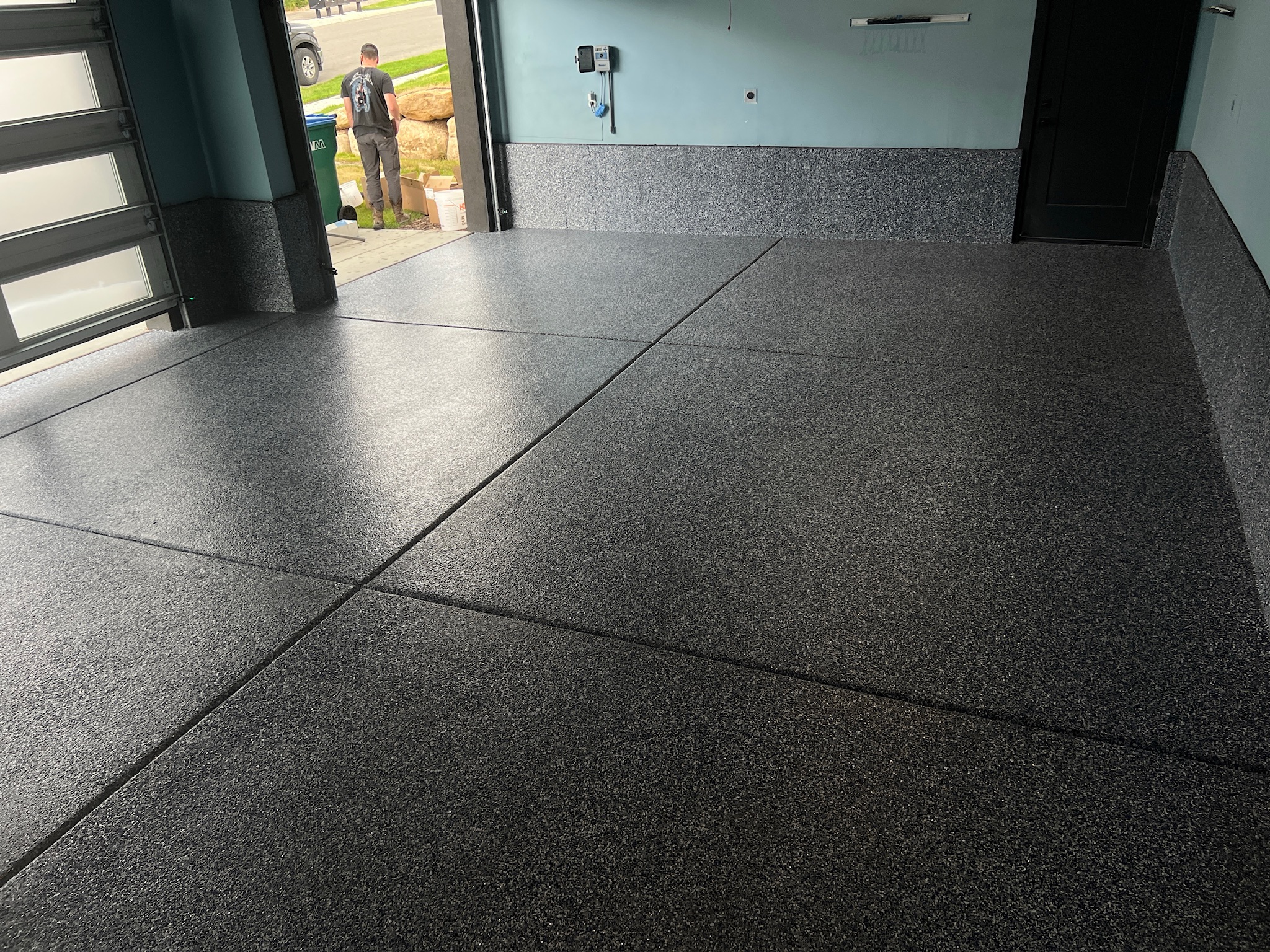 Coated baseboard trim carried up the wall, which is what keeps a mop from leaving a dirty line at the floor edge.
Carriage houses, damp slabs, and vapor
A fair number of Chestnut Hill garages are not attached to anything. They sit at the back of the property, unheated, often built into a slope, with a slab poured straight onto soil long before anybody put plastic under concrete. Those floors run cool and damp most of the year, and moisture pushing up from underneath is the single most common reason a coating lets go here.
So we test before we quote, not after. Where the reading comes back high we spec a moisture-mitigating primer and say so in the scope. Where it comes back fine, we tell you that too and you save the line item. What we will not do is put a standard system on a wet slab, take the money, and wait for the phone call in August. If your garage floor feels cold and slightly tacky under your hand on a humid day, mention it when you call.
Permits are a Philadelphia question up here rather than a township one, which trips people up since the neighborhood feels suburban. For a floor coating it does not come up at all. It is a finish over existing concrete, so there is nothing to file.
Salt, freeze, and the door edge
Every winter the city salts the Avenue and the side streets, and every car that pulls into a garage up here carries a load of brine in on the tires and drops it on the concrete. It soaks in, it sits, and when the temperature swings the water in those cracks freezes and levers the slab apart a little further. That is why so many neighborhood garages are pitted worst in the first four feet inside the door, exactly where the tires stop.
A single-coat kit has no answer for that. Neither does bare concrete. The system we install does, because the polyaspartic wear layer on top is rated for salt and for the heat coming off tires that have just come down Bethlehem Pike. Underneath it, the rebuilt apron gives the freeze nothing to pry at. For heavier vehicles and shop floors the same buildup applies, which is covered on our Chestnut Hill commercial epoxy page.
Frequently Asked Questions
Can a 90-year-old Chestnut Hill garage slab still take a coating?
There is old paint on my garage floor. Does that have to come off?
My detached garage feels damp. Is that a problem?
Do I need a Philadelphia permit for a garage floor coating?
How long is my garage out of use?
Will road salt off Germantown Avenue damage the finish?
Is the work warrantied?
Free garage floor quote in Chestnut Hill.
We come out, measure the floor, read the concrete, and put the whole scope in writing. No deposit and no pressure. Call the shop or request the quote here.
(445) 444-2879