A floor you get back the next day
Most people calling us about polyaspartic have a scheduling problem, a weather problem, or both. The garage cannot sit torn up for a week, and the calendar already says November. This resin solves that pair of problems in a way standard epoxy cannot, which is why so much of what we install around Chester runs on it.
One day on site, then it is yours
Grind in the morning, base coat, broadcast the chip, roll the clear, and leave. That is a realistic day for a two-car garage when the crew arrives staged and the slab is sound. You walk on it that night. The cars come back the next morning. Nobody parks on the street for a week or shuffles the contents of a garage twice.
The reason is cure speed. Epoxy needs long overnight windows between coats and then a further stretch before anything with weight rolls onto it, which is how a garage job stretches to four or five days. Polyaspartic sets in a fraction of that time, so the coats stack inside a single shift. On a working household in Chester, or a shop that loses money every hour the floor is closed, that difference decides the whole job.
We give you real return-to-service hours for your slab before we book the date. Cold concrete slows things down and we will say so rather than promise you a morning that does not exist. Reach us at (445) 444-2879 and we will talk through your actual timeline.
The material is not the hard part. Being ready when it goes off is.
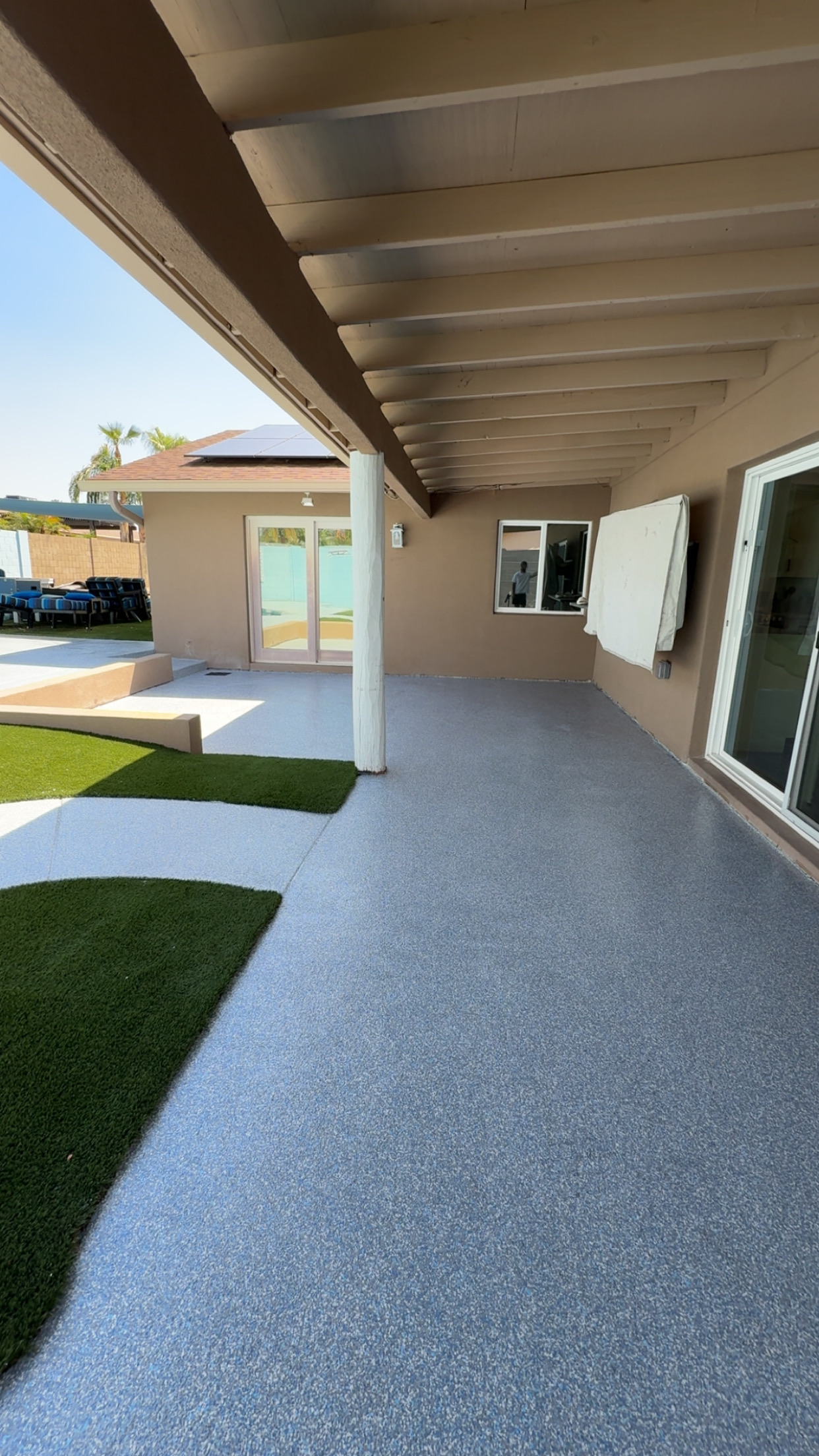
 A finished exterior slab running from under the roofline out into open sun, half the surface exposed all afternoon.
Cold slabs, and why the season lasts longer
Epoxy quits before winter does
Resin chemistry slows as concrete cools. Push epoxy onto an unheated slab in late fall and the cure drags, the finish goes soft or streaky, and below a certain reading it simply will not harden the way it should. Detached garages, carports and any exterior pad in Delaware County hit that reading long before the calendar says winter. Every year we field the same call in October from somebody told their floor has to wait until spring.
Polyaspartic keeps reacting
This resin family cures across a much colder band, so a Chester garage or covered porch can be coated in months when epoxy is off the table. It buys back roughly half the year on unheated concrete.
Moisture is the other reading
Cold weather brings condensation, and a slab that looks dry can be pulling moisture up from underneath. That is a bond problem no coating survives. On below-grade and older pours we test before anything gets mixed, and where vapor is moving we say so and price the moisture-tolerant primer into the written quote rather than discovering it later.
 Full chip broadcast under a clear wear layer, the pairing we use on almost every covered outdoor floor.
Sunlight, tires and the clear coat on top
Two things wreck an exposed floor: ultraviolet light and hot rubber. Standard epoxy loses to both. Left uncovered it ambers within a season or two, so the color you chose drifts warm and blotchy where the sun lands hardest. Park a car on it after a summer drive and the heat in the tread can grab a softer surface and lift it in patches. Polyaspartic is built to hold up under both, which is the entire reason it goes on porches, uncovered patios, and any garage whose door spends the afternoon open.
It is rarely the color, though. On most floors we install, the clear polyaspartic is the top layer over a base that carries the pigment and a chip broadcast that carries the texture. You choose the blend, we lock it under the wear coat, and the finished surface looks the same as any of our decorative work while gaining the sun and tire resistance. Choosing this system never means accepting a bare gray slab.
Short working time is the whole risk
The speed that makes this material worth buying is also what wrecks it in untrained hands. Once the parts are mixed, a batch has minutes, not hours, and it does not wait for anybody. A crew that falls behind leaves lap lines where one wet edge cured before the next met it, roller marks that will not level out, and thin patches that start peeling within a year. Nearly every failed polyaspartic floor we have been called out to grind off went bad exactly that way. The product performed. The install did not.
So we plan around the clock. Sections get sized to that day’s temperature, batches get mixed in sequence rather than all at once, and the floor moves as one continuous surface so it cures as a single piece. Prep gets stricter, not looser: diamond grinding to open the concrete, crack and joint repair, moisture testing where the slab warrants it, all finished before anyone opens a pail. There is no going back to fix a spot once material is down. Everything that makes a fast floor last happens before the first batch.
None of that shows up in the finished surface, which is the point. What you see is an even floor with no seams and no shadows in it. What you got was a crew that had the whole thing staged before they started. That is the part worth paying for, and it is what our walkthrough is really pricing.
Where plain epoxy is the smarter buy
We talk people out of this system regularly. Indoors, away from daylight, the UV advantage you would be paying for does nothing at all. A finished basement, a utility room, a back office floor: none of them see the sun, and epoxy lays down thicker and fills a rough or pitted pour more generously than a fast-setting clear ever will. On those rooms we point you toward a heavy epoxy build and put the difference into grinding and patching, which is where it actually shows.
Warehouse and shop floors split on the same question. If a Chester commercial slab sits under roof with no exposure and the shutdown window is long enough, epoxy can be the better value. If the crew has to be back on that floor tomorrow, or forklift tires run hot across it every shift, the calculation flips. We ask what the space actually does before recommending anything, which is why our answer changes from one building to the next.
The honest version is that neither material wins everywhere. Sun exposure, cold-weather scheduling and downtime push toward polyaspartic. Shade, rough concrete and a patient calendar push toward epoxy. We look at your slab, ask what it has to survive, and tell you which one we would spend our own money on. If that turns out to be the cheaper system, the quote will say so in writing.
Straight answers before you book
How long before I can park on it?
Can you install this in December?
Will hot tires pull the coating up?
Does it fade on a sunny patio?
Should I just get epoxy instead?
Can I get color and texture too?
Working the Chester side of the county
Broomall is a short run down to the Chester riverfront, so getting a crew out to look at a slab here is a matter of days. Alongside this system we handle metallic epoxy for feature floors and commercial epoxy for the shops and facilities around Chester City. Everything on the Chester services page is available at the same turnaround.
Reserve a walkthrough for your slab
We come out, read the concrete, check what light and traffic it takes, and put the scope in writing before a grinder ever touches it. No deposit. If epoxy is the better answer for your room, that is what the written quote will recommend.
(445) 444-2879