A poured floor that moves like water
Metallic epoxy for Chester basements, finished garages, showrooms, and dining rooms, mixed and worked on site by a coatings crew that came out of fine art.
Where the artist background actually earns its money
Twelve years of making art before ever mixing resin is the sort of line that sounds like a brochure until you watch a metallic pour go down. The pigment does not stay where you put it. It drifts, it stacks, it feathers out along the trowel path, and once it starts moving you have somewhere between forty minutes and an hour to decide what the floor becomes. There is no undo. That single window is why a coatings crew with a composition habit produces a different result from one following a spec sheet, and why we treat metallic as a separate service instead of a color option bolted onto a garage package. For Chester owners, the practical translation is that we walk the room before we quote anything: where light enters, what the walls are doing, which direction people come in from.
 A finished bay with the door up: copper and rust drifting through a near-black field, and a bright reflection of the window grid sitting right on the surface.
Which Chester rooms this belongs in
Four kinds of space account for almost all of the metallic we pour around here, and they want different things from it.
A basement pour is mostly about light. Below grade in an older Chester house you are working with a couple of small windows and whatever fixtures are up in the joists, and a gloss metallic under a clear coat throws that light back instead of swallowing it. A finished garage is the opposite problem: the door opens onto full daylight, so the color has to hold up under direct sun as well as under bulbs. Commercial spaces bring a third question entirely, which is traffic. A dining room floor takes chair legs and mop buckets seven days a week, and that changes which topcoat goes on top rather than whether metallic is right at all. If the space you have in mind is a business, the Chester commercial epoxy page covers scheduling and systems for that side.
Grinding, then flatness, then color
Read the room and the slab together
Light sources, entry points, and the concrete itself get looked at in one visit. Old patches, saw cuts, and control joints all show through a metallic layer, so we note them before anything else.
Diamond grind and profile
Mechanical grinding opens the concrete so the primer can key into it. Sealers, glue residue, and paint from a prior life all come off here rather than being coated over.
Chase the flat
Poured metallic pools in low spots and reads dark there. We straightedge the slab, knock down ridges, and fill hollows so the finished color stays even across the room.
Approve boards in your own light
Samples come to the space and get looked at during the hours you actually use the room. Under showroom lighting a color reads one way; under two basement windows it reads another.
Base coat, then the pour
A pigmented base sets the ground color, and the metallic goes over it wet. Solvent, air, and torch move the pigment into veining while the resin is still open.
Clear UV-stable topcoat
The wear layer protects the artwork and keeps the color from ambering under sun. It is standard on every floor we pour, never an add-on line.
Walkthroughs cost nothing. Call (445) 444-2879 or reach us through the contact page to get on the schedule.
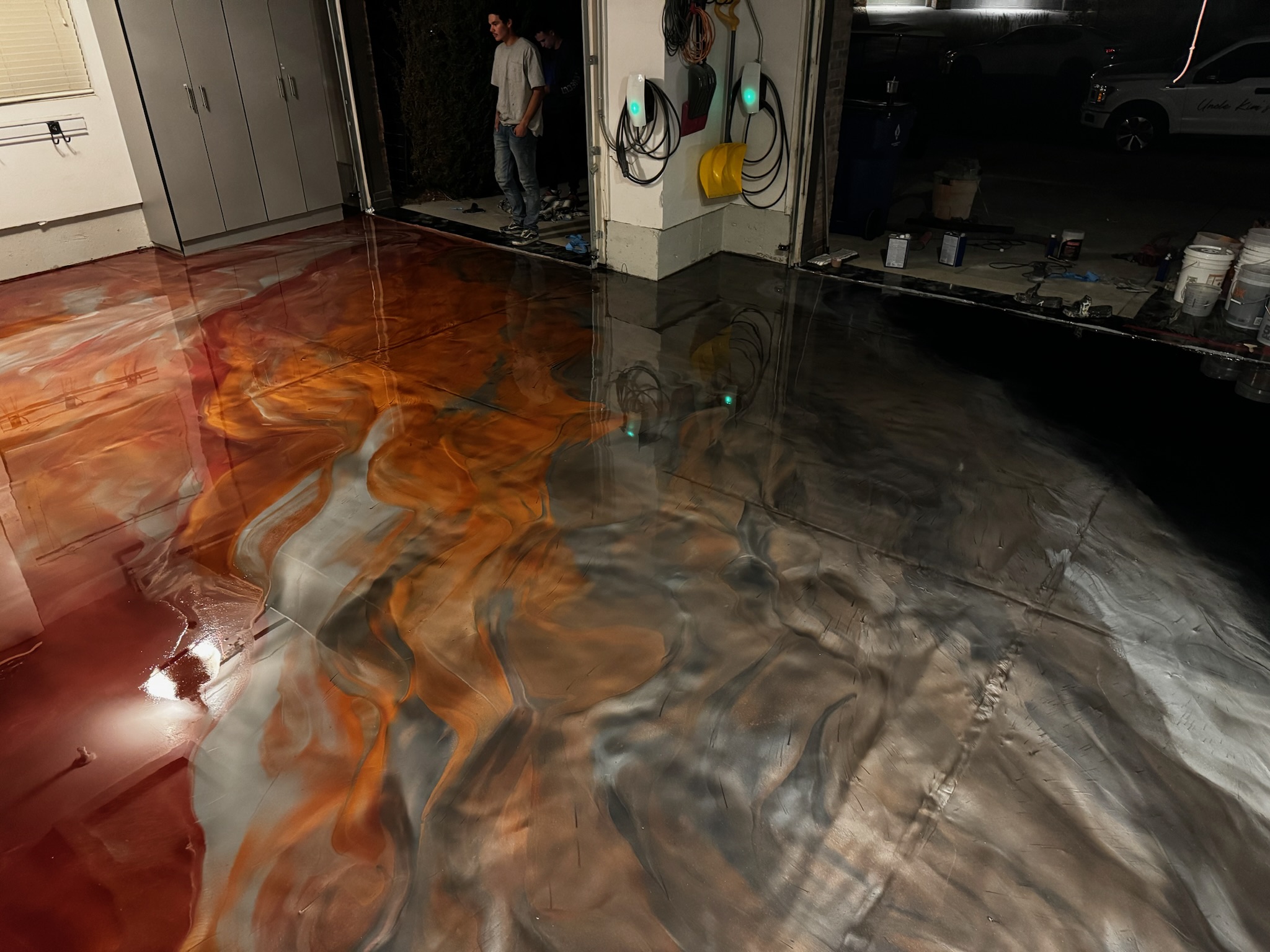 Mid-pour after dark, with the resin still open: rust and orange feeding into silver while the crew works from the far bay toward the door.
Pennsylvania weather sets the calendar
Resin is temperature sensitive on both ends of the year, and pretending otherwise is how floors go wrong. July here brings heat plus humidity, and warm resin kicks faster, which shortens the window for working pigment and can trap haze under the topcoat if the dew point is wrong. January brings the opposite: a cold slab pulls heat out of the mix, the material thickens, the metallic stops drifting the way it should, and cure times stretch out. Neither is a reason to refuse the work. It is a reason to plan it. In summer we start early and control the air in the space. In winter we want heat on the slab, which is easy in a conditioned basement or an occupied storefront and harder in a detached garage that has been sitting cold. When the conditions are not workable we move the date instead of pouring anyway.
A metallic pour is one continuous hour of decisions. Weather is one of the voices in the room.
When we tell you to buy flake instead
Plenty of Chester calls that start with metallic end with us recommending something else, and it is worth saying why before you spend the premium. Metallic is a decorative system with a wear layer on top. It handles normal life fine, but it shows scuffs and chips more honestly than a flake floor does, and it does not spot-repair invisibly. If the space is a working garage where a truck comes in loaded with road salt every winter week, or a shop where things get dragged across the floor, flake epoxy hides wear better, and a polyaspartic system cures faster and takes sun harder. The same logic applies to a plain utility bay that just needs to stop dusting, which is garage floor coating territory. We would rather route the job than sell you the pretty option and hear about it in two years. Tru Coat is Don Resin Class Certified and Microcement Certified, and those trainings cover the whole family of systems, not only the one with the highest ticket.
The other honest note is repeatability. Each pour is its own event, so we lock the palette and the character from approved boards, not the exact pattern. Finished floors are worth looking at in the project gallery before you decide, and other work around town is listed on the Chester service area page.
What Chester owners ask first
How flat does my slab have to be first?
Can you pour metallic in a Chester winter?
Will sunlight from a storefront window fade it?
Can you match the sample exactly across the whole floor?
Is metallic the wrong call for a working garage?
How long before we can walk on it and move furniture back?
Hold color against your own walls first
Broomall is a short run down to Chester, PA, so getting boards into your basement, bay, or storefront is easy to arrange. We check the slab for flatness and moisture, look at how light lands in the room through the day, talk through where flake or polyaspartic would serve you better, and put the whole scope in a written quote. No deposit is required to have that conversation, and there is no follow-up pressure afterward. Send the details here and we will pick a time.
(445) 444-2879