
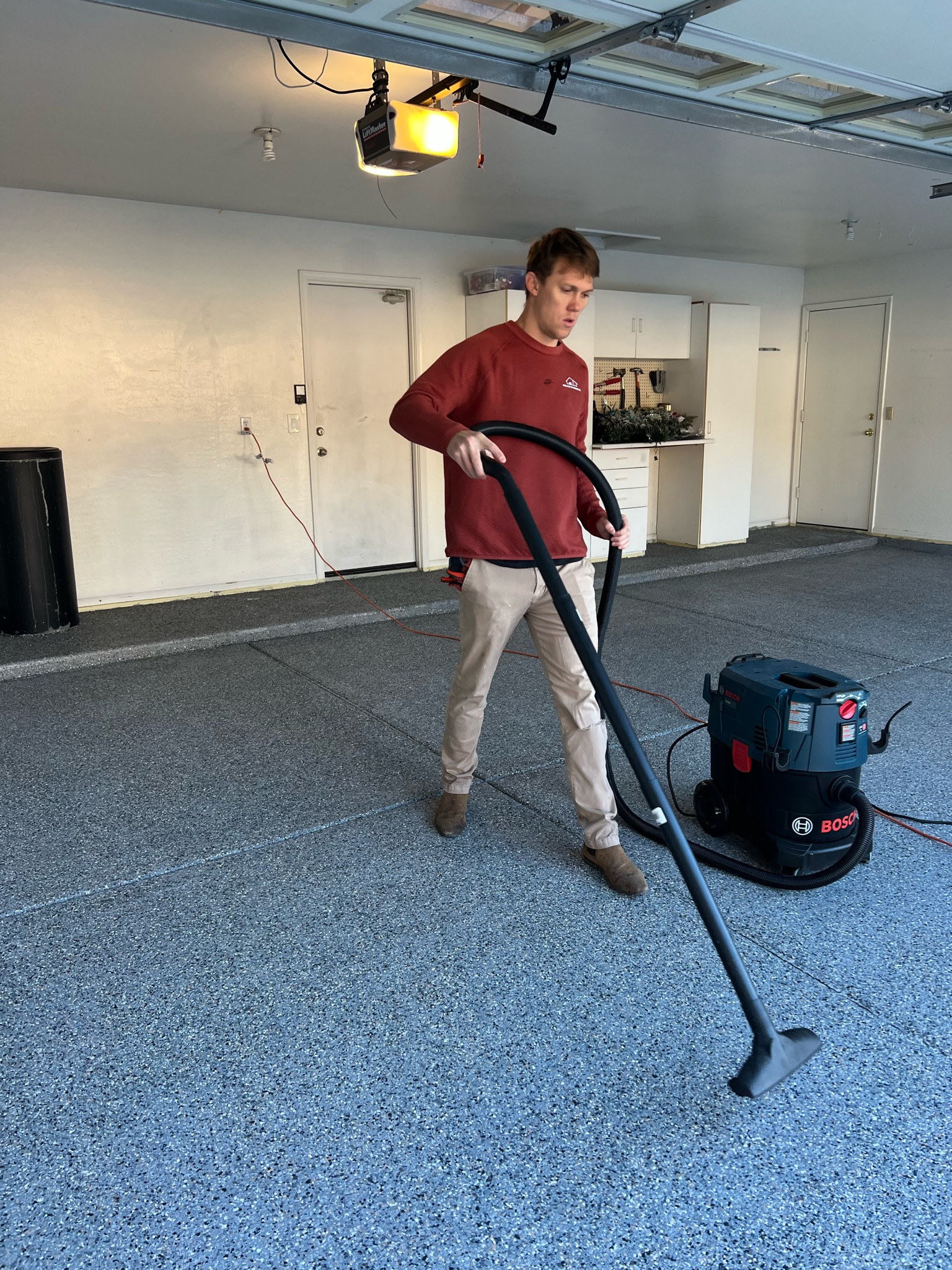
Prep is most of an epoxy job. We clear the floor and read the slab, test it for moisture, diamond-grind it with HEPA dust extraction running the whole time, then repair the cracks, spalls and joints the grinder uncovers. By the end of prep day your floor looks rougher than it did that morning, and that is exactly how it should look. Call (445) 444-2879 or reserve a walkthrough.
Most people picture a floor job as the day the color goes down. That is the day that photographs well. The day that decides whether the floor lasts comes earlier, and from the outside it looks a lot less exciting: a grinder, a vacuum about the size of a suitcase, a crew on their knees with a crack chaser, and a slab that ends up looking worse than when we arrived. Here is what prep day looks like at a Haverford house, step by step, and why we will not shorten it.
An empty floor to start
Prep starts with you, a little. We ask that the floor be cleared before we arrive: cars out, shelving emptied or moved, bikes and bins parked somewhere else. Anything bolted down gets talked about at the walkthrough so nobody is surprised. If something truly cannot move, we plan around it. The cleaner the starting point, the more of the day goes into the concrete instead of into shifting boxes.
We also ask about power and access. The grinder and dust extractor need a good outlet, and a basement job needs a clear route down the stairs. If someone in the house has to get a car out early, tell us. We would rather learn the household routine ahead of time than block a driveway at the worst possible moment.
Reading the slab before touching it
The first thing the crew does is look. Old paint or a clear sealer from a previous owner shows up as patches that bead water or lift at the edges. Oil stains where a car used to park go deeper than they appear. Efflorescence, the white powdery bloom on some slabs, tells us moisture is moving through the concrete and carrying salts up with it. Spalls, where the top of the slab has broken away, tend to gather at the garage door and near the steps. Then come the cracks and the control joints, which each need their own treatment.
Every one of those changes the plan for the day. Paint and sealer have to come off completely. Oil needs grinding and sometimes a degreaser before a coating will bond. Efflorescence sends us straight to the moisture test. We note what we find and show it to you, so you know what is under your floor before we cover it up.
Moisture first, mixing later
Nothing gets mixed until we know what the slab is doing with water. A sheet of plastic taped to the concrete, or a meter reading, gives a straight answer. Concrete that pushes vapor up through itself can lift a coating months down the road, and no amount of careful grinding fixes that.
If the reading comes back dry, we move on. If it comes back damp, the floor gets a primer made for that condition before any color system, and we will have walked you through why. This step is quiet and quick next to the grinding, but it protects everything that follows. It is also the step we find skipped most often on the failed floors we get called out to redo.
Grinding, with the dust going into a bag
This is the loud part. A diamond grinder takes the top skin off the slab and leaves the surface open and slightly rough, a bit like fine sandpaper, so the coating has something to grip. Along the way it removes old coatings, stains and the weak top layer that would otherwise poison the bond. Grinding is our default because it gives an even, predictable surface on every floor.
Grinding concrete makes fine dust, and nobody wants that drifting through their house. Our grinders run hooked to a dust extractor with a HEPA filter, and the same machine comes back out at cleanup, on the finished floor. The dust gets pulled in right at the grinding head instead of floating into the air. Edges and corners the big machine cannot reach get a hand grinder on the same vacuum. When the grinding is done, the slab gets vacuumed again, and the rooms upstairs stay the way you left them.
Fixing what the grinder uncovers
Grinding often reveals more than anyone could see before. Hairline cracks open up, small voids appear and spalled edges show their real size. Cracks get chased out with a blade so they are clean and wide enough to take a repair, then filled and ground flush. Spalls are rebuilt with repair mortar so the surface is level again, especially at the garage door, where tires land first.
Control joints stay open. We clean them out and carry them up through the coating, so the slab keeps moving the way it was designed to. On an outdoor slab that matters even more, as our patio coatings page for Haverford explains. Inside, if you are adding a cove base, this is also when the bottom of the wall gets prepped for it, a detail covered on our cove base page.
Why the floor looks worse at five o’clock
By late afternoon on prep day, your floor looks rough. It is dull, gray and patched in places, and you can see every repair line. That is a good floor. It is clean, open, tested and sound, and it is ready to hold a coating for a long time.
Coating day is a different scene. The color goes down, the flake gets broadcast, the topcoat goes on, and the room changes in front of you. People remember that day. We just want them to know that what they are looking at was settled earlier, on the floor they barely noticed. Our epoxy floor prep page for Haverford homes describes the prep service on its own, including for people planning ahead. If you are comparing quotes, ask each contractor what happens on prep day. The answer tells you plenty.
Prep Day FAQ
Do I need to be home during prep?
Not for the whole day. We like to walk the floor with you in the morning so we can show you anything the slab reveals, and we will call if something changes the plan. Otherwise the crew works on its own. We do need access to power and a clear path in and out of the space.
How much dust ends up in the house?
Very little. Every grinder we run is connected to a HEPA dust extractor that pulls the dust in at the grinding head. We close off doors to the rest of the house where we can and vacuum the slab when grinding is finished. It is loud for a few hours, and the dust goes into the extractor bag rather than onto your furniture.
Why does prep take as long as it does?
Because every square foot gets ground, every crack gets opened and filled, and the floor gets tested and vacuumed before anything is mixed. Skipping any of that is faster, and it is how coatings fail. The time goes into the parts of the floor you will never see, which happen to be the parts that keep it bonded.
If your slab has old paint, oil stains or a white bloom you have been ignoring, all of it is fixable on prep day. We are a Broomall company, a short drive from Haverford, and every quote is itemized, free and explained line by line. The gallery shows where that prep ends up.
Find Out What Your Slab Needs First
Diamond grinding with HEPA dust control, moisture testing and real repairs, explained to you standing on the floor.
Reserve a Walkthrough Reach the CrewOur full Haverford Epoxy Floor Prep page · See finished floors · Request a quote
