Pewter and bronze floors for lower levels
Hand-poured metallic epoxy for Chestnut Hill basements, lower levels, and interior rooms where slate and hardwood do not make sense over an old slab.
A finished interior floor, not a garage novelty
The reason it keeps coming up here is practical. Hardwood below grade is a gamble on any older slab, and slate or tile means building the floor up, losing headroom you may not have, and living with grout. Coating the slab itself keeps the ceiling where it is and ends with one continuous surface. The owner spent twelve years as an artist before turning to coatings, and metallic is the service where that shows: the pigment work is done by hand, in the room, in real time.
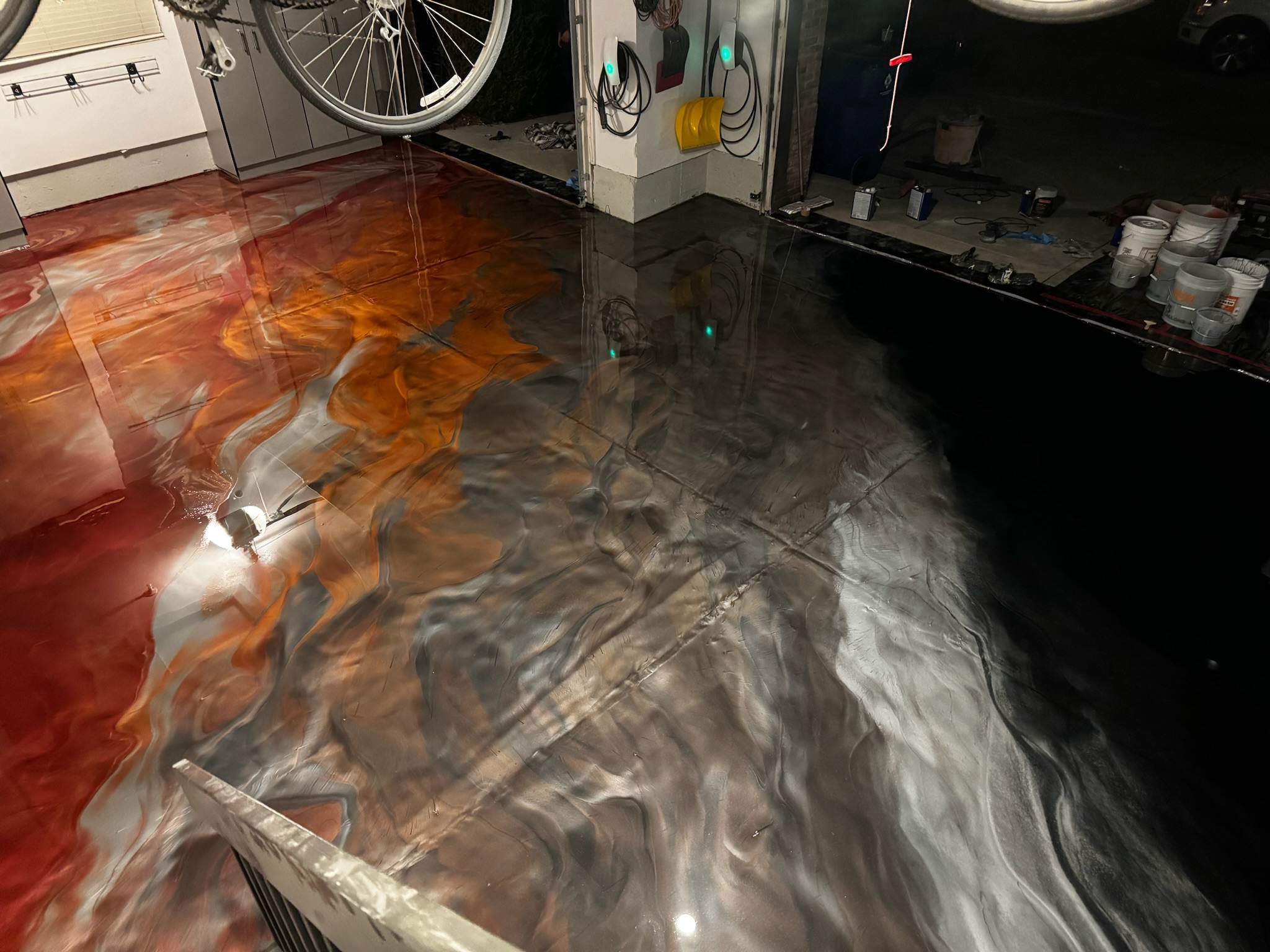 Copper and pewter worked wet, then locked under a clear polyaspartic wear layer.
Tones that sit with schist, slate, and old woodwork
Half of this job is color restraint. Chestnut Hill interiors already carry a lot: Wissahickon schist showing through in the foundation walls, slate on the roof, chestnut and oak trim that has darkened for a century. Drop a bright teal and copper floor into that and the room fights itself. The tones that hold up are the quiet ones, and they are the ones we steer people toward.
Light behavior matters just as much, and it is the thing people get wrong. Lower-level rooms up here often have two small windows at grade and whatever the recessed cans give you. A gloss metallic floor throws that light back into the room and the space stops feeling like a basement, which is usually the whole point of the renovation. If a mirror finish feels like too much next to old woodwork, a satin topcoat keeps most of the brightness and reads softer. We look at your actual lighting before either of us commits to a direction, and we bring sample boards into the room to do it. See finished pours in the project gallery.
How the pour actually goes
Walk the room and read the slab
We look at the light, the walls, and the concrete itself. Old patches, cold joints, and any sign of moisture get noted before anyone talks about color.
Moisture test and diamond grind
Older slabs under stone houses can push vapor. We test, then grind mechanically to open the surface and cut out the failed patches. Nothing gets poured over a slab that is not ready.
Approve a sample under your light
Boards come to the room, not to a showroom. You pick a direction standing in the space at the hour you actually use it.
Primer and pigmented base
A keyed primer, then the ground color laid to spec thickness. That base is the canvas, and it decides how deep the metallic layer reads.
Metallic pour and hand work
Pigments are dispersed and moved with solvent, air, and torch to build the lacing and depth. This is the hour that makes the floor, and it cannot be rushed or repeated.
Clear polyaspartic topcoat
The wear layer goes over the cured metallic. Without it you have artwork you cannot walk on, so it is standard on every pour rather than an upgrade line.
Every project starts with a free walkthrough. Call (445) 444-2879 or use the contact page and we will get on the calendar.
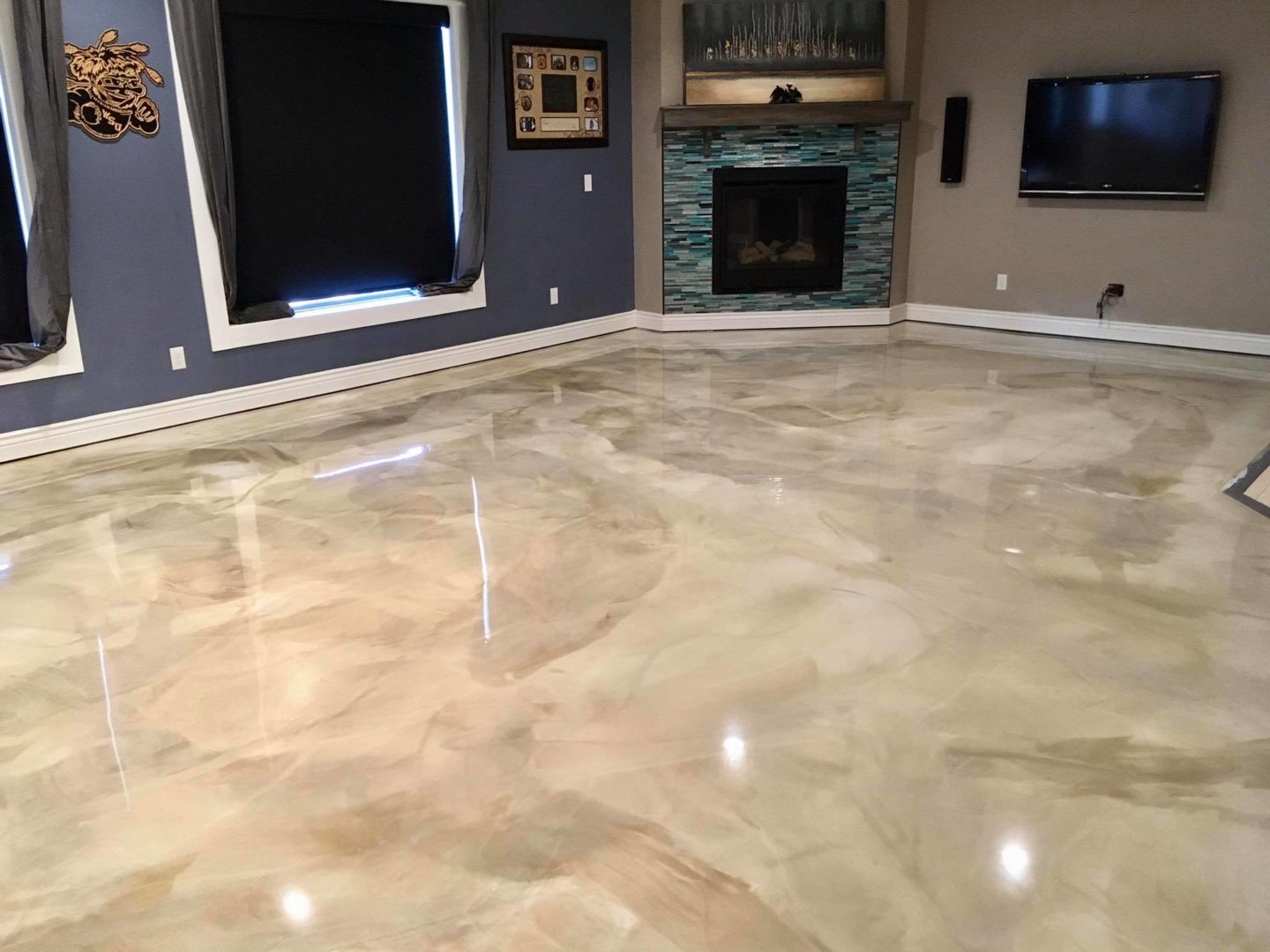
One sealed surface, and old-house dust has nowhere to go
Anyone who has owned a stone house here knows the dust. Plaster grit, sand from the mortar joints, whatever drifts down from a hundred-year-old floor system above. Carpet holds it, tile grout traps it in lines, and both need real effort to get clean. A finished metallic floor is one sealed sheet with no seams and no fibers, so it comes clean with a dust mop and a damp pass.
The pour is a one-time event. We can hold a direction, we cannot hold a photograph.
Being straight about what you are buying
Every metallic floor is unique, which sounds like marketing until you understand it cuts both ways. The pigments move differently every time depending on temperature, humidity, how the base is drawing, and how the pour is worked. That is why the floor has depth a printed product can never fake. It also means we cannot duplicate a photo from the internet or a floor a neighbor has. We approve a direction from sample boards and hold to it, and we tell you the truth about the range instead of promising an exact copy.
The other honest note is scope. Metallic belongs where the floor is meant to be looked at. If you are coating a working shop or a space that takes real abuse, a flake or quartz build is tougher and costs less to maintain, and we will say so before you spend the premium. For a business space on Germantown Avenue the calculation is different again, and that lives on the Chestnut Hill commercial epoxy page. Other services and neighborhoods are covered from the Chestnut Hill service area page.
Questions we get in Chestnut Hill
Can a metallic floor go over an old stone-house slab?
Which colors sit right with older interiors?
Will it brighten a dark lower level?
Can you duplicate a floor I saw?
How does it handle old-house dust?
How long is the install and when can we use the room?
Is the work warrantied?
Bring the sample boards to your lower level
We come out, read the slab, hold color against your walls and your light, and put a real scope in writing for Chestnut Hill, PA. No deposit, no pressure. Request the quote here.
(445) 444-2879