Pouring a Feature Floor Into an Old Building
A poured metallic finish is decided by the slab before it is decided by the color. Older Chester concrete is rarely flat, and metallic settles into every low spot and reads dark there. Flatness work, a single continuous pour window, and honest talk about window glare come first. Call (445) 444-2879 or ask for the written quote.
People come to metallic through a photograph. Something with depth in it that looks like polished stone or moving water, in a finished basement or a small showroom, and the question is whether that can happen on the concrete they already own. Sometimes the answer is a straight yes. Sometimes the honest answer is that the room wants a different system, and saying so is part of the job. What follows is the sequence we actually walk through before mixing anything.
The slab has to be flat before it can be beautiful
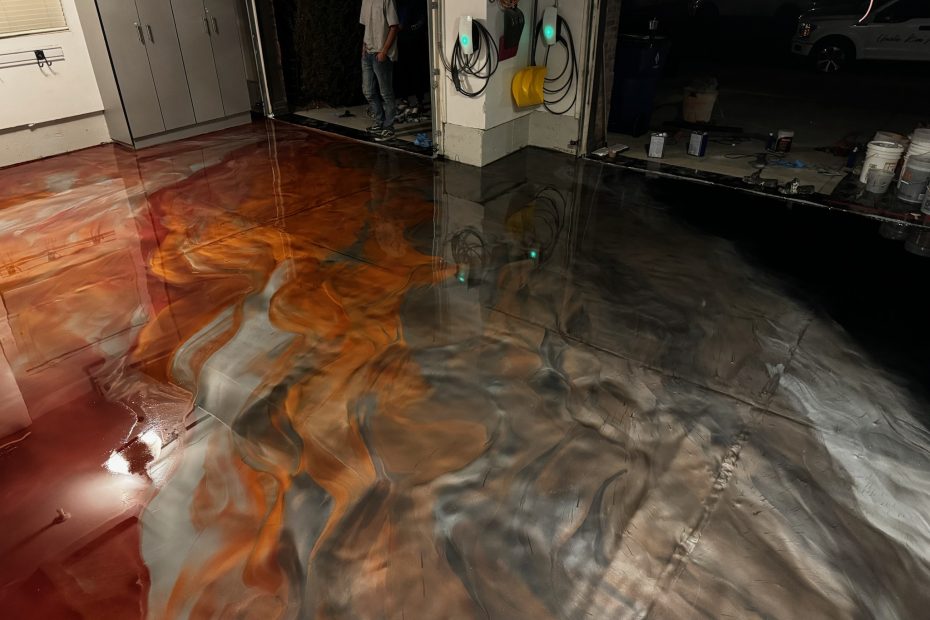
Poured metallic is a self-leveling material, which sounds like a feature and is actually the constraint. It flows to the low points. Wherever the slab dips, more material collects, and more material means more pigment depth, which reads visibly darker than the surrounding field. On a floor that is out of plane you get shadowy patches that look like water stains, and they are permanent.
Older buildings are rarely flat. Slabs poured decades ago were finished by hand to a standard nobody thought would ever matter, then patched, cut for a drain, and worn unevenly in the traffic path. So we map the floor with a straightedge before quoting a color, knock down the ridges with the grinder, and fill the hollows until the plane is consistent. That work is unglamorous, it is where the day goes, and it is the single largest difference between a poured floor with depth and one with puddle marks in it.
The other thing to know is that anything with a hard line in the slab telegraphs upward. Old patches, saw cuts, and control joints will all be legible through a metallic layer, so we identify them on the first visit and tell you what they will look like rather than letting you discover it.
The pour is one continuous event
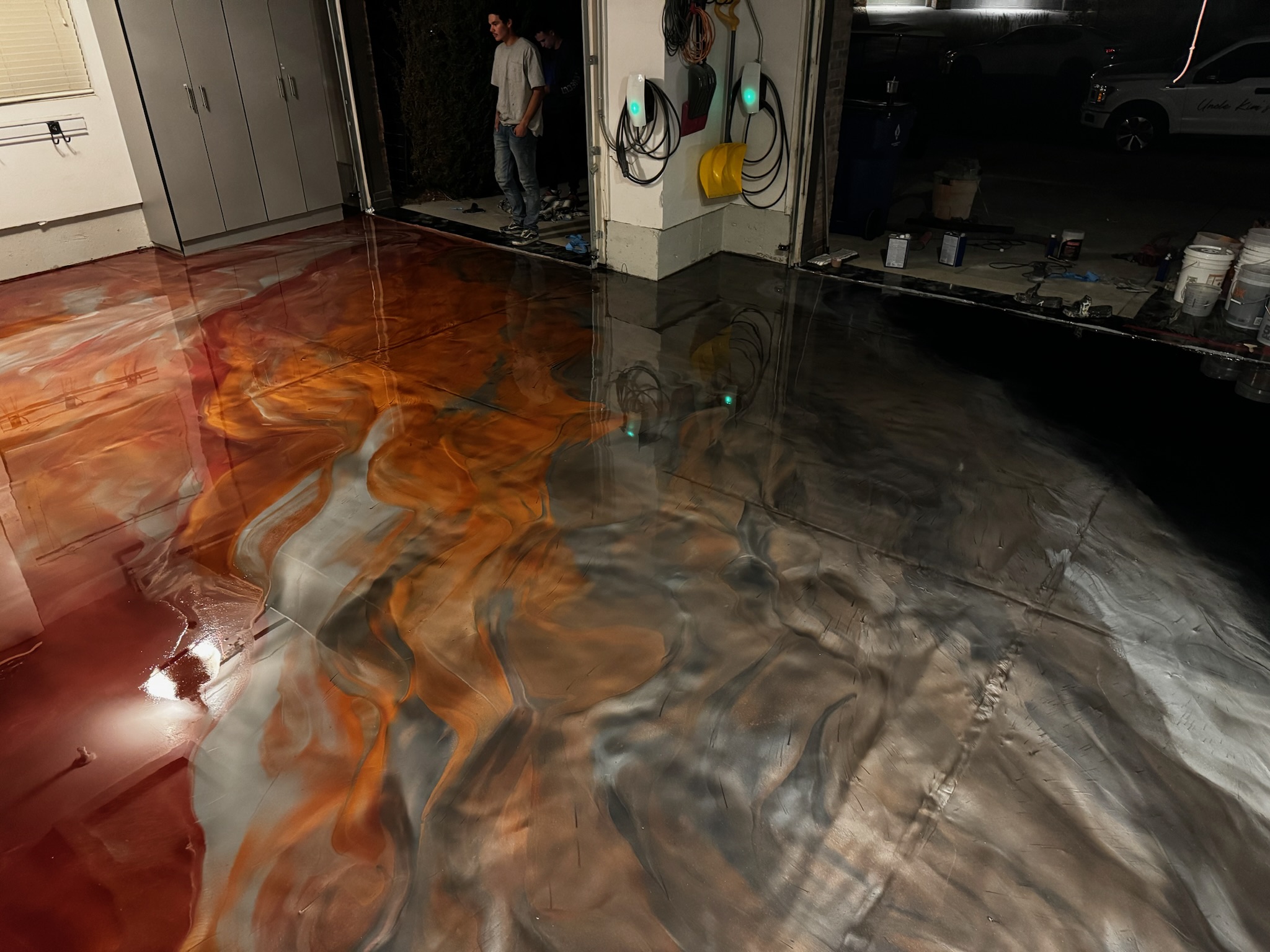
Every other coating we install can be paused. A metallic pour cannot. Once the resin is mixed and on the floor, the pigment moves for a limited window, and everything the finished surface will ever be gets decided inside it. Solvent, air, and heat push the color into veining while the material is still open, and when it starts to set, that is the floor.
That means staging is most of the work. The room is prepped, taped, and cleared beforehand. Material is proportioned in sequence rather than mixed all at once. The crew starts at the far corner and works toward the exit so nobody is ever standing where the floor already is. If a section had to wait, the wet edge would set before the next batch met it, and the seam would sit in the middle of the room permanently.
It also means the crew size and the room size have to match honestly. A larger floor needs more hands, not a longer day, and if the numbers do not work we tell you before booking. This is the part of the job where an artist’s habit of committing to a decision and living with it is more useful than a contractor’s habit of fixing things later.
Windows, sun, and where the light lands
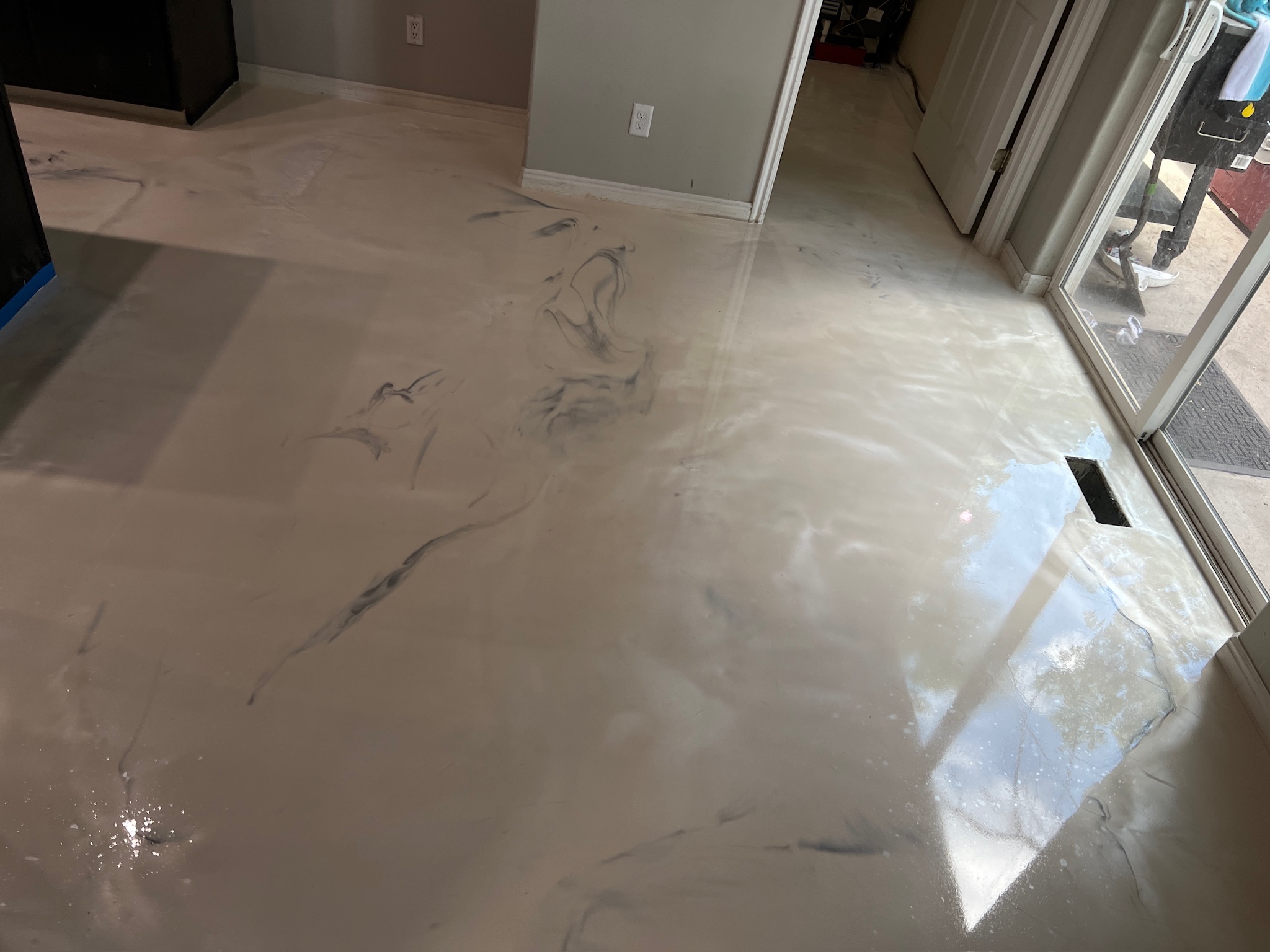
A glossy poured surface is a mirror, and that changes the room in ways a photograph never shows. In a basement with two small windows near the joists, the floor picks up whatever daylight arrives and pushes it back into a space that has never had much. That is usually the argument for metallic down there in the first place.
In a room with real glass, especially a storefront or a converted space with south-facing windows, the same reflectivity means the color you approve under interior lights will read differently at two in the afternoon. Bright light flattens the veining and washes out subtle contrast, so a palette that looked rich in the evening can look pale at noon. We put light exposure on the record before mixing so the palette is chosen for the room as it actually behaves.
Direct sun raises a second issue. Bare epoxy ambers under ultraviolet light, which drifts the color warm and blotchy over a couple of seasons. That is why every pour gets a clear UV-stable wear layer over the cured metallic. It is standard on our floors rather than an upgrade line, and near a big window it is doing real work.
When we tell you to buy chip instead
Metallic belongs where the floor is part of the room. A finished basement, a small showroom, a dining space, a garage that functions more like a gallery than a workshop. In those rooms it earns every dollar because you look at it constantly.
It is the wrong call for a bay that works for a living. If a car comes in weekly with road salt and slush under it, if tools get dropped, if the floor takes real abuse, chip hides wear far better and touches up more easily. A scratch on a poured metallic is visible in a way a scratch in a chip broadcast simply is not, because there is no texture to break up the reflection. We route those jobs to flake rather than sell somebody the more expensive system and let them find out.
The last honest note is repeatability. Each pour is its own event. Pigment behaves the way it behaves once it hits wet resin, so the veining near the door will not match the veining at the far wall, and we do not promise it will. Sample boards lock the palette and the general character, not an exact pattern. Anyone showing you a photograph and promising to reproduce it has not poured many floors. The range of what we can hold is in the gallery, and the full system is on our Chester metallic epoxy page.
What the schedule looks like in a finished room
Plan on the room being out of use longer than a chip floor takes. Grinding and flatness work, the base coat, the metallic pour, and the clear wear layer each want their own cure window, so a metallic install runs across several days rather than the two a garage chip floor takes.
Below grade there is one more gate before any of it starts. Older basements sit on slabs poured without a vapor barrier underneath, and ground moisture travels up through the concrete for the life of the building. We meter that first. A high reading changes the primer and adds a day. Skipping the test is how a beautiful floor lifts in sheets two summers later, and no finish survives a bond problem.
You get the walk-on date and the furniture date in writing before we start. If a schedule cannot be met at the temperature your room is actually sitting at, we move it rather than rush a pour that cannot be redone.
What owners ask before committing
Will my basement floor drain or floor vent show in the finish?
Anything the resin has to terminate against will be visible as an edge, and that is normal. What we can control is how clean that edge is. Drains, vents, and thresholds get cut in deliberately during prep so the boundary looks intentional instead of like the pour ran out of room.
Can you pour metallic in a room I still have to use?
Not partially. The pour has to happen as one continuous surface, so the whole room comes out of service for that window rather than half of it. If the space cannot be fully cleared, that is worth raising early, because it usually changes either the schedule or the system.
How do I clean a poured floor once it is finished?
A damp mop and nothing aggressive. There is no wax, no sealer to reapply, and no annual maintenance. Grit is the only real enemy, since dragging it under furniture is what puts fine scratches in a glossy surface, so a mat at the entry does more for the floor than any product will.
Look at Color Where the Floor Will Live
We straightedge the slab, check the light at the hours you use the room, and leave sample boards behind. Written scope, nothing owed for the visit.
Reserve a Walkthrough (445) 444-2879