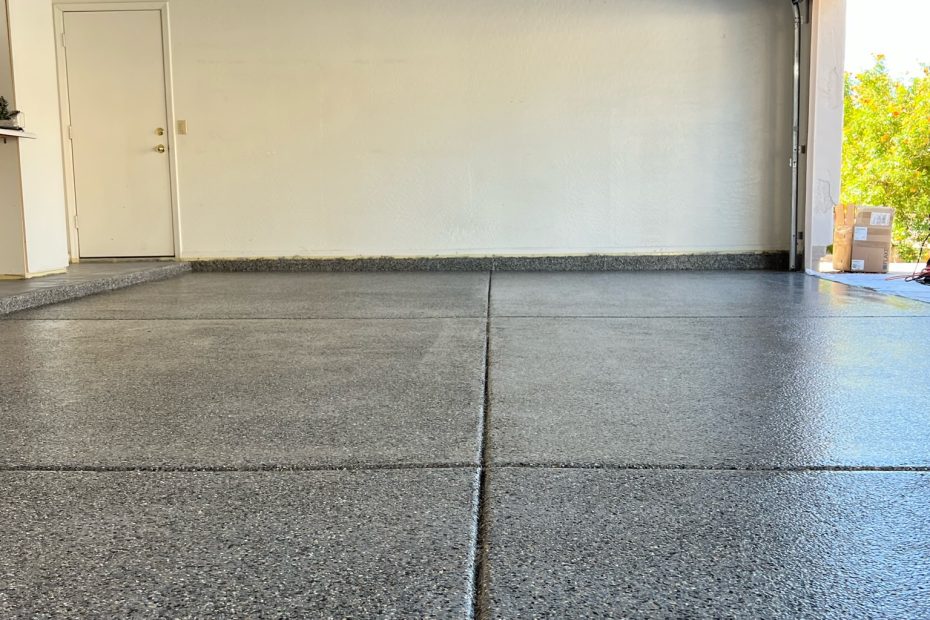
Sizing the Chip to a Small Chester Bay
In a narrow rowhome or twin garage you stand close to every square foot, so quarter-inch chip usually reads right and half-inch reads coarse. Blend does the other half of the work: the right mix swallows old patches and hides tracked-in grit between cleanings. Call (445) 444-2879 or ask for a free quote.
Most people choosing a chip floor look at a photograph taken from six feet up in somebody else’s three-car garage. Then they stand in their own single bay, where the walls are close enough to touch with both arms out, and wonder why the sample does not feel like the picture. Scale is the whole reason. A blend that looks balanced across forty feet of open floor can look busy across twelve. Here is how we actually pick both halves of the decision for the garages this city has.
Distance is what your eye is really judging
Chip size is not a durability question. A quarter-inch broadcast and a half-inch broadcast, both thrown to refusal and sealed, hold up the same way. What changes is how the pattern reads at the distance you will be standing.
In a narrow bay you are never more than a few feet from the wall on either side. Every step puts your eye maybe five feet above the surface, and at that distance a half-inch chip resolves as individual pieces. The floor stops reading as a texture and starts reading as a scatter of objects, which is the visual equivalent of shouting in a small room. Quarter-inch at the same distance blurs into a field with depth in it.
Open up the room and the calculation flips. A wide detached garage or a full basement floor gives your eye enough run to absorb the larger piece, and it earns you a bit more tooth underfoot in exchange. There is no correct answer that ignores the room. Bring the samples into the actual space and the choice usually makes itself inside a minute.
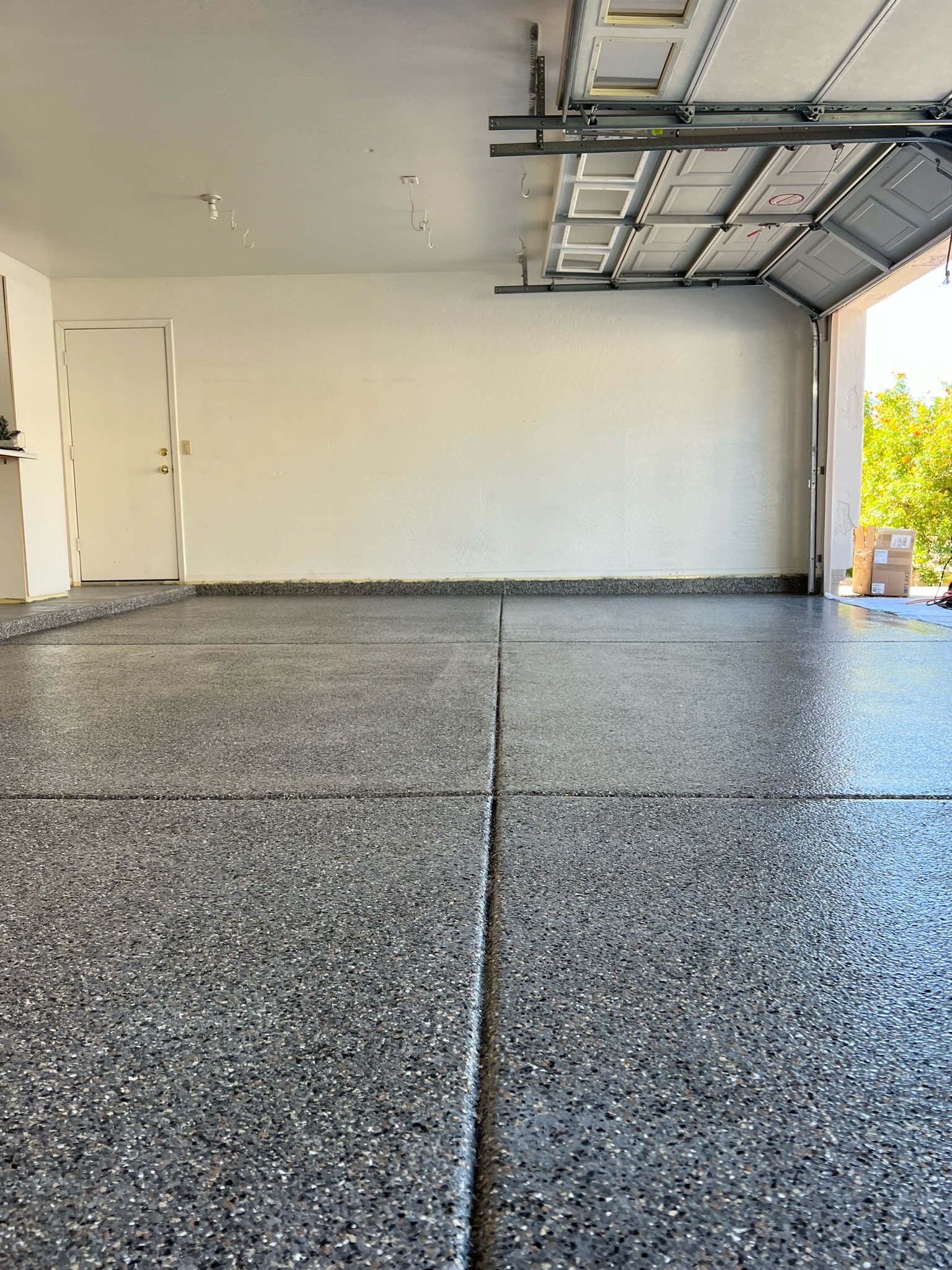
What a blend can bury, and what it cannot
Older garages carry history. A patch where a post used to sit, a strip of different concrete from when a drain went in, color variation from three separate repairs by three separate people. Owners often assume all of that has to be removed before the floor can look finished. It does not.
A full chip broadcast is a light-scattering surface. Thousands of small pieces at slightly different angles break up reflection so the eye never settles on a continuous plane, and a repair underneath simply stops registering. We grind the patches flush with the surrounding slab, refill anything that has cupped, and once the chip is down the seams are gone visually even though the concrete history is still there.
What a blend cannot hide is a plane that is out of level or a joint that is still moving. Chip disguises color and small texture differences, not geometry. If your slab has a dish in it that holds water, that gets addressed during prep, because no blend is going to argue with a puddle.
Picking a blend that suits Chester housing
The rowhomes and twins around here lean toward brick, stone, and painted trim, with a good deal of visual activity already in the walls. A floor that competes with that makes a small garage feel smaller. The blends that work hardest are the ones that stay quieter than everything around them.
Blue-gray with black and white flecks is the workhorse. It disappears under a parked car, and more usefully it hides the grit and dust that a working garage accumulates between cleanings, so the floor looks maintained on a Wednesday and not just the day after you mop. Warm tans and browns do the same job with a different temperature, and they suit a bay that doubles as a workshop or storage.
Light matters as much as color. A single bay with one small window and a couple of fixtures is a dim room, and a dark blend absorbs what little light there is. Something with white or light aggregate in the mix bounces the fixtures back and makes the space read wider than the tape measure says.

Sample boards go on your slab, not our bench
Color decisions made under shop lighting are decisions made in the wrong room. The owner spent twelve years working as an artist before ever coating a floor, and one thing that carries over directly is refusing to judge color anywhere except where it is going to live.
So loose samples come to your garage and stay on the concrete. You look at them in the morning with the door up, and again at night with only the fixtures on, because those are two genuinely different floors. Hold a board next to the base of your wall, next to the door frame, next to whatever cabinets are already in there. A blend that looked perfect on a table can fight with a trim color you were not thinking about.
Bring your own opinion to that visit. We will tell you what we would put down and why, but you are the one parking in it. The range of what a finished chip floor can look like is in the gallery, and the system itself is laid out on our Chester flake epoxy page.
Texture, cleaning, and the way you actually live in the bay
The other thing the chip does is give you grip. A full broadcast leaves a fine profile you can feel through a shoe, which matters in a room where somebody comes in off a wet sidewalk with snow on their boots. A plain gloss coat with nothing thrown into it looks sharp in a photograph and gets slick the moment it is wet, so we do not spec that for a working garage.
Cleaning is where most people notice the difference day to day. The sealed surface has nowhere for dirt to settle into, so a broom takes the dry mess and a damp mop takes the rest. Salt crust in February comes off with water rather than a scraper. If the layout allows it, a coved base band carried a few inches up the wall removes the floor-to-wall seam entirely, and then you can hose the whole thing out instead of scrubbing a corner where grit collects every winter.
Nothing needs waxing or resealing on a schedule. If you chip a spot dragging something heavy across it, call us, because a chip floor spot-repairs cleanly and there is no reason to live with a mark on it.
Common questions about chip and blend
Can I mix two chip sizes in one garage?
You can, and occasionally it makes sense when a bay opens into a separate storage room and you want the two spaces to read differently. In a single continuous floor we generally advise against it, because the transition line becomes the most noticeable thing in the room and it will not sit where the eye wants it to.
Will a lighter blend show tire marks and dirt more?
Less than people expect. Marks show against uniform color, and a multi-tone blend gives the eye too much variation to lock onto. A very light solid would be a problem. A light blend with darker flecks worked into it is one of the more forgiving surfaces you can put in a garage.
How do I know the broadcast is dense enough?
Get down and look across the floor at a low angle before the clear goes on. A floor broadcast to refusal shows no base color anywhere between the pieces. If you can see pigment through the gaps, the chip layer is thin, and that thin spot is where the wear will start.
See the Blends on Your Own Concrete
We bring samples to the bay, measure the room, read the slab, and leave you a written quote with nothing owed for the visit.
Reserve a Walkthrough (445) 444-2879